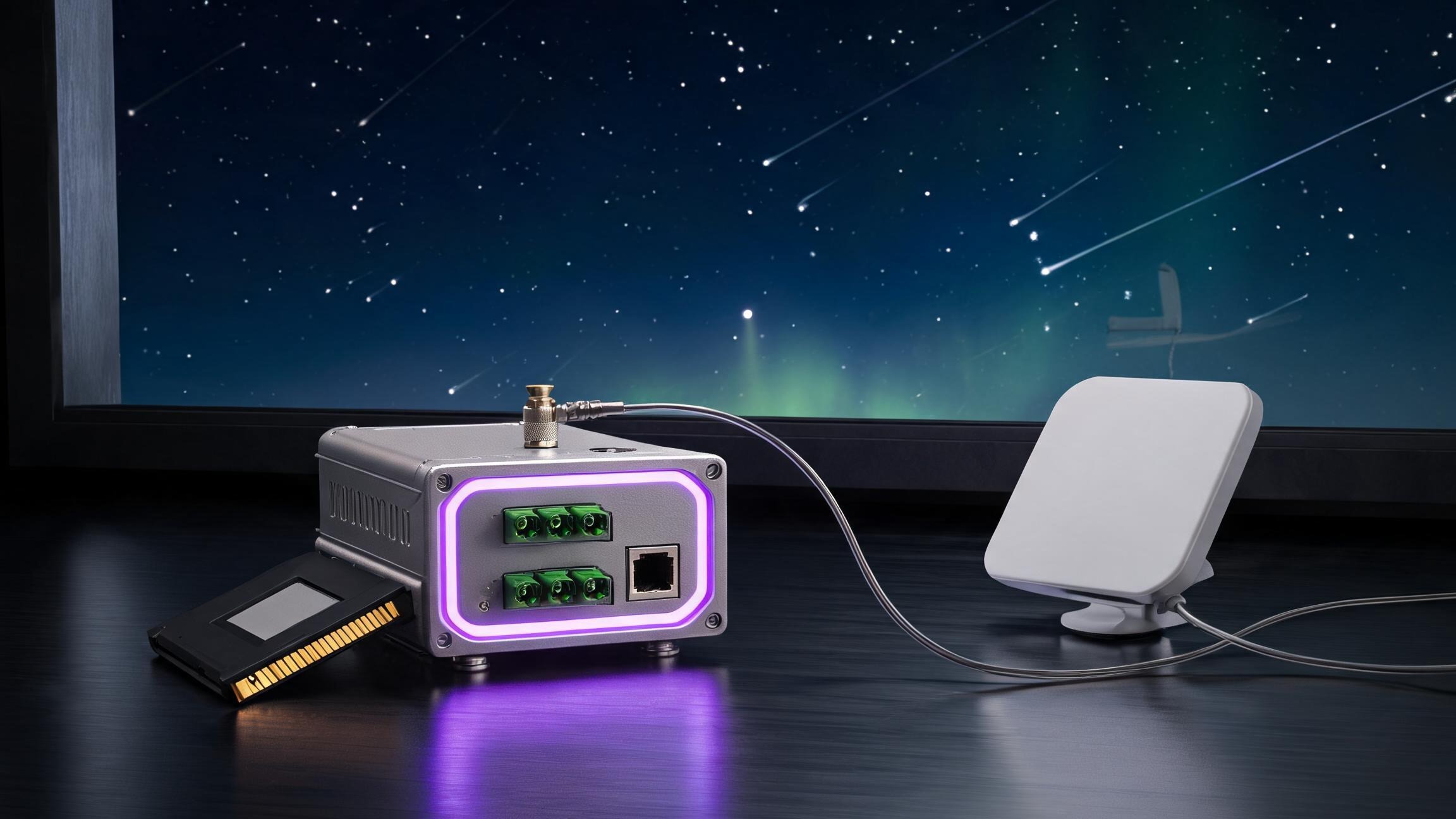
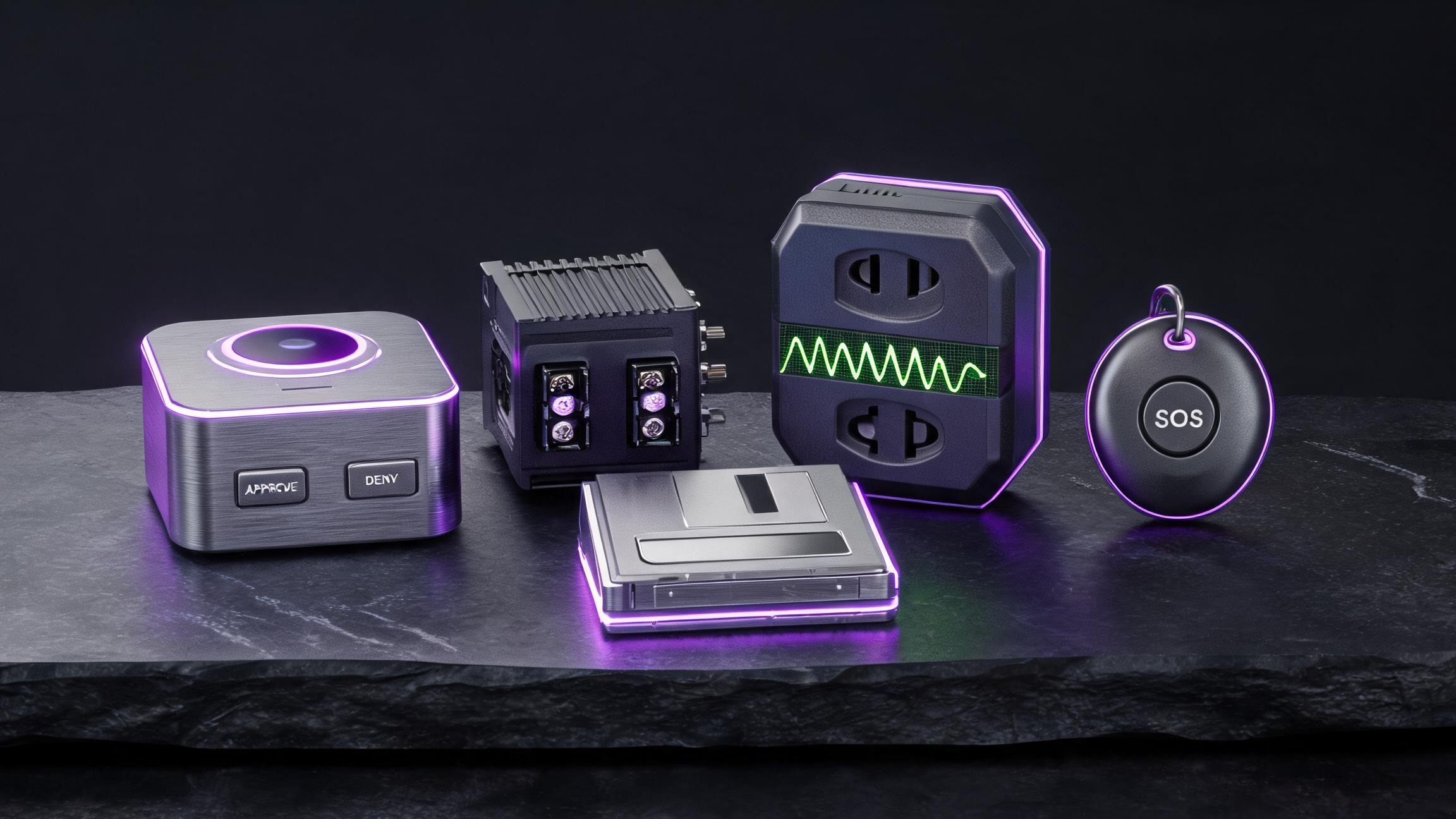
Grok Deck is an open-source hardware companion for AI agents — an industrial gateway that lets Grok touch real machines: Modbus, CAN/J1939, OBD-II, BLE, LoRa. Cloud supercompute on tap through a physical Approve gate, Starlink backhaul where there's no ground network, and prepaid compute credit in an encrypted cold-wallet cartridge.
Independent community project — not affiliated with, endorsed by, or connected to xAI. "Grok" is an xAI trademark; used here to indicate protocol compatibility only.
Where compute happens is negotiable. Where the boundary lives is not — five rules, enforced in hardware, identical for every agent:
A sub-4B model plus anomaly detection, resident on the gateway NPU. Baselines, weather math, risk briefs — never offloaded. Pull the network and everything still works: the offline night-shift loop is an EVT hard gate.
Large-model inference through the gate: consent card present → declared fields cover the request → Approve pressed. Requests carry aggregated features only; responses land signed on the cartridge. API unreachable? Degrade silently to Layer 1.
Rangeland, pump stations, valleys — no ground network required. LoRa near-field aggregation at the node, satellite uplink at the gateway. We integrate nothing and resell nothing: users bring their own terminal. The layer is detachable by design.
The same floppy-form encrypted cartridge that stores your data stores your prepaid compute credit. Cloud inference is priced per token, denominated at a USDT-pegged rate:
Credit lives in the secure element — cold storage, offline-readable, follows the card across devices. Swap the gateway, keep the balance.
Every cloud call decrements once, inside the element — double-spend impossible. Deduction records pair one-to-one with call audits.
Credit packs are denominated at a USDT-pegged rate. The card stores a number only — no token issued, nothing on-chain, no yield, no appreciation. A prepaid meter, not a wealth-management product.
Refill by one-time signed voucher, confirmed at the Approve button. A gift card is a physical voucher — give the card, give the compute.
The body doesn't pick a brain. Any MHS-compatible agent — Grok, OpenWorker, your own private model — binds through the same registry and faces the same button. Swapping an agent is a software action; swapping a body is a retooling.
Compute in space. Data in the card.
| # | Check | Pass condition |
|---|---|---|
| V1 | Offline night-shift loop | 8 h unplugged: sense → infer → store → write, full function |
| V2 | Signed call chain | Any cloud call resolvable to a five-field audit tuple (caller · model · tokens · deduction · balance) |
| V3 | No-consent refusal | Card pulled → every cloud call fails immediately, no bypass |
| V4 | Double-spend | Two concurrent deductions → balance decrements once |
| V5 | Balance migration | Card moved to another device → balance and audit intact |
| V6 | Brain swap | Agent image reflashed on the same unit → binding succeeds, hardware untouched |
| V7 | API degradation | Endpoint down → task continues in local mode, UI labels it |
Design freeze (now) → EVT (~10 weeks) → DVT (~8 weeks) → PVT & certification (~6 weeks) → production (~8 weeks). Full architecture note: any-agent-architecture.md · Hardware-binding spec PR: andrewyng/openworker#596 · Parent project: OpenWorker Deck